
Clean Power
Pure sine wave inverter power — the kind of clean power EVs should have.
Cleanest PowerBuilt for roadside professionals and entrepreneurs getting into the business.
On average, adds approximately 5–10 miles of range in about 20 minutes to help stranded EV drivers reach the next charger.
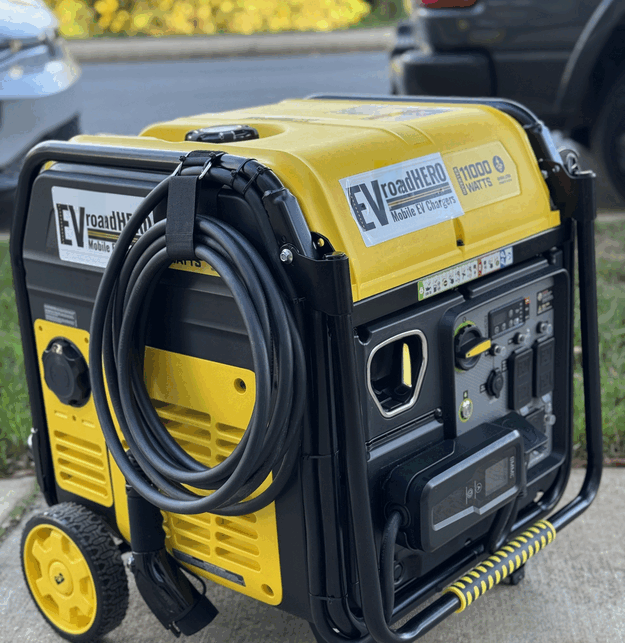






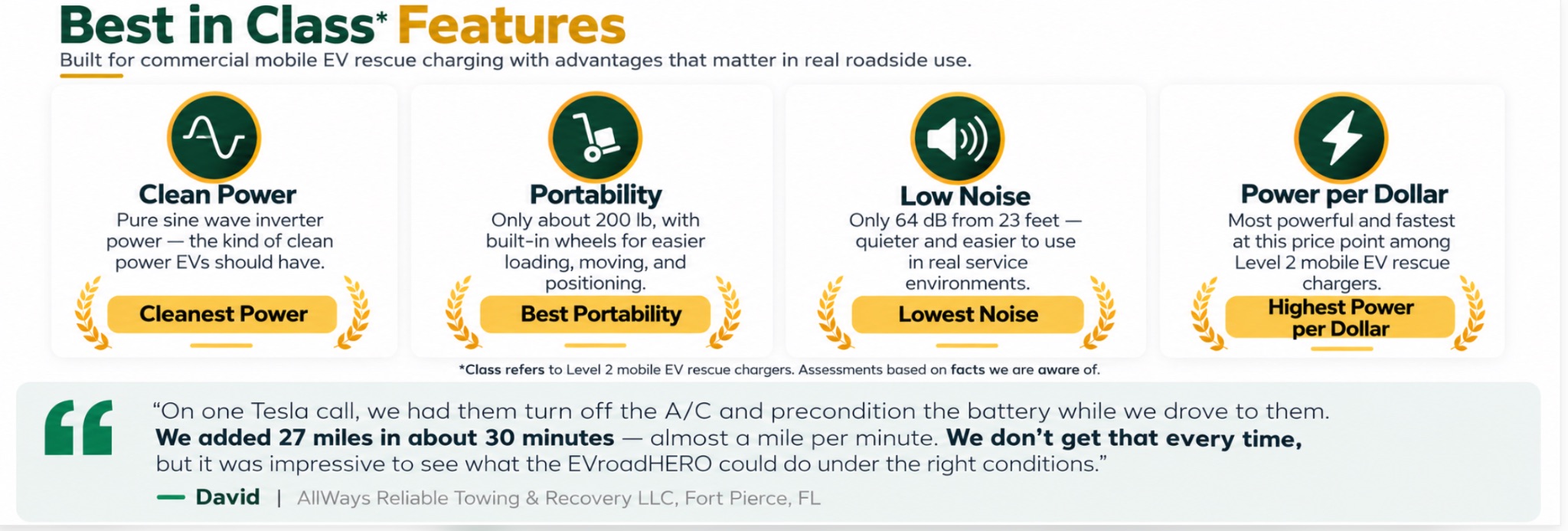
*About “Best in Class.” “Class” means Level 2 (AC) mobile EV rescue chargers marketed in the United States for roadside use. “Cleanest Power,” “Best Portability,” “Lowest Noise” and “Highest Power per Dollar” are EVroadHERO’s own comparisons, based on the manufacturers’ published specifications and prices that we have reviewed. They are not independent tests, products and prices change, and noise (64 dBA at 23 feet), weight (about 200 lb) and power (9 kW continuous) are EVroadHERO’s published specifications. Customer comments reflect individual experiences, and results vary with the vehicle, battery state, temperature and other conditions. Questions about the comparison? Contact us.
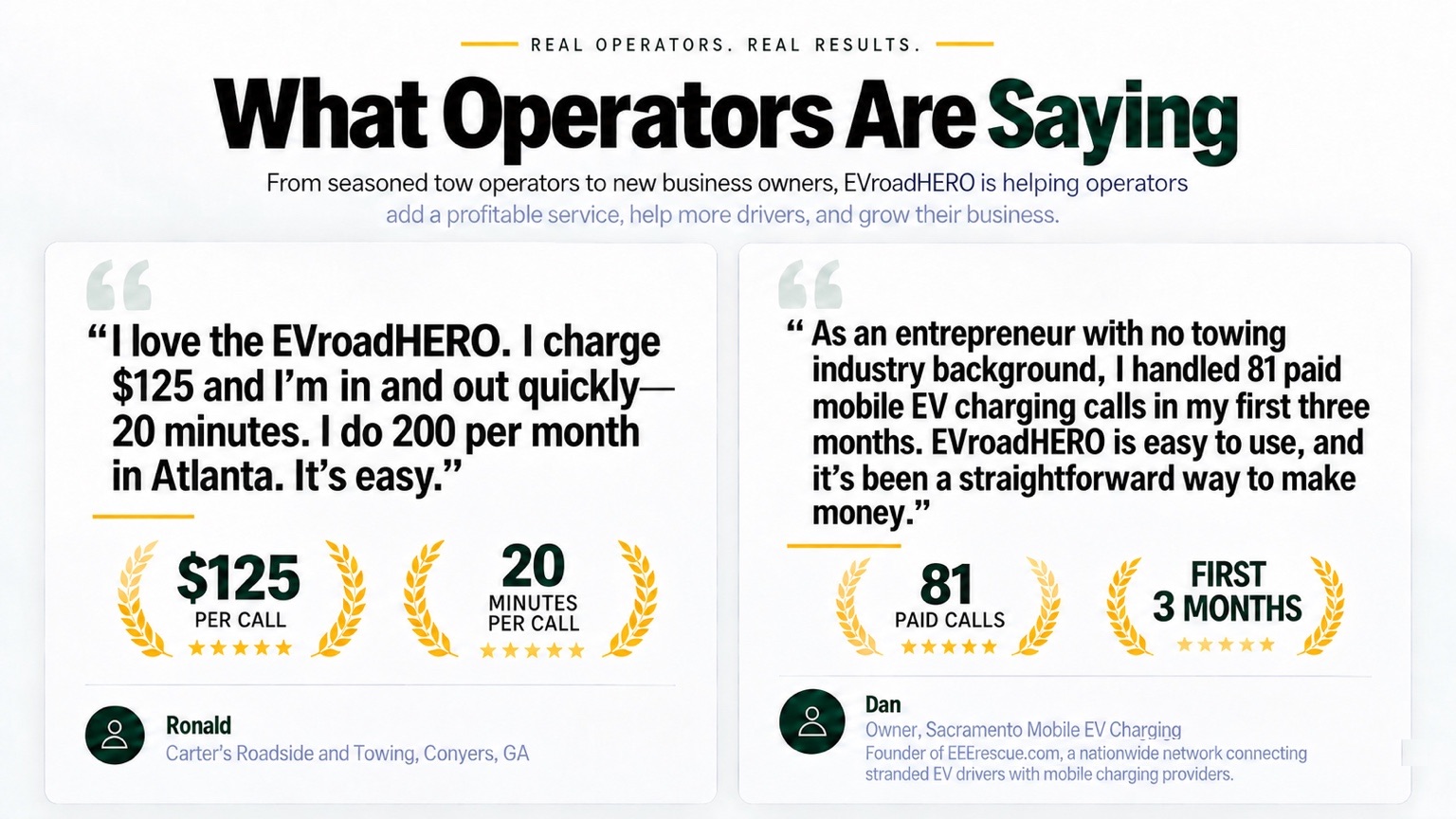
Built for commercial mobile EV rescue charging with advantages that matter in real roadside use.
Pure sine wave inverter power — the kind of clean power EVs should have.
Cleanest PowerOnly about 200 lb, with built-in wheels for easier loading, moving, and positioning.
Best PortabilityOnly 64 dB from 23 feet — quieter and easier to use in real service environments.
Lowest NoiseMost powerful and fastest at this price point among Level 2 mobile EV rescue chargers.
Highest Power per Dollar*Class refers to Level 2 mobile EV rescue chargers marketed in the U.S. for roadside use. Comparisons are EVroadHERO’s own, based on published manufacturer specifications and prices we have reviewed; they are not independent tests.
“On one Tesla call, we had them turn off the A/C and precondition the battery while we drove to them. We added 27 miles in about 30 minutes — almost a mile per minute. We don’t get that every time, but it was impressive to see what the EVroadHERO could do under the right conditions.”
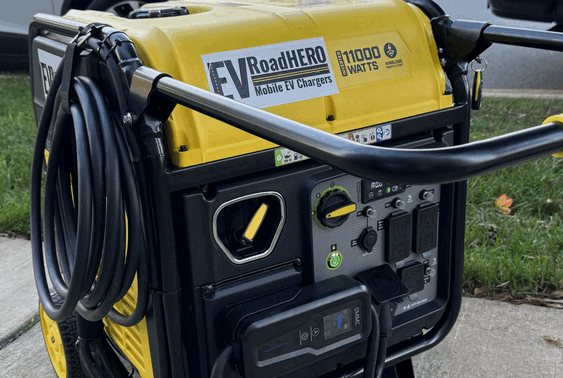
From seasoned tow operators to new business owners, EVroadHERO is helping operators add a profitable service, help more drivers, and grow their business.
“I love the EVroadHERO. I charge $125 and I’m in and out quickly—20 minutes. I do 200 per month in Atlanta. It’s easy.”
Ronald
Carter’s Roadside and Towing, Conyers, GA
“As an entrepreneur with no towing industry background, I handled 81 paid mobile EV charging calls in my first three months. EVroadHERO is easy to use, and it’s been a straightforward way to make money.”
Dan
Owner, Sacramento Mobile EV Charging
Founder of EEErescue.com, a nationwide network connecting stranded EV drivers with mobile charging providers.
When an EV runs out of charge, a tow isn’t the only option. In many cases, a quick charge can get the driver back on the road and to the next charging station — saving time, money and hassle for everyone involved.
EVroadHERO gives you a practical, proven solution for real-world roadside situations.

 Faster than a tow
 Safer than a tow
 Avoids EV driver climbing in and out of your truck
 Light duty truck and operator

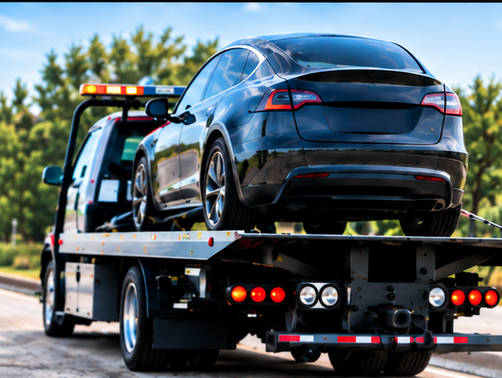
 More time for the driver
 Higher cost
 Inconvenient and disruptive
 Increases emissions

EVroadHERO helps you provide a valuable service, keep customers moving, and create new opportunities in the growing EV market.

AAA handled EV roadside events in 2023. About 4% involved vehicles that had run out of charge — roughly 6,400 rescue charges through AAA alone.

If AAA represents 25% of the market, that implies approximately 25,000+ EV rescue charging events nationally in 2023.
EVs on U.S. roads are projected to grow from about 4.5 million to about 11 million by the end of 2026.

Using the same assumptions, roughly 50,000 EV rescue charging events may occur annually by 2026.

At an estimated $200 per session, that suggests about a $10 million annual U.S. mobile EV rescue charging market by 2026.

AAA’s mobile EV charging capability was reportedly available in only 24 U.S. cities in 2023.
The EV rescue charging market is real, growing, and wide open. Now is the time to get into this growing area and start your EV rescue charging business.
Source summary: AAA, TIME, and EEI / ICF. The $10 million figure is EVroadHERO’s own estimate built from the assumptions shown above (the AAA event count, an assumed 25% AAA share of the market, projected EV growth, and an assumed $200 per session). It is not a forecast from a research firm and is provided for educational purposes only; actual results will vary.
Practical information for tow operators, roadside professionals and entrepreneurs getting into mobile EV rescue charging.
Rescue charging is like bringing a small amount of fuel to a stranded car, just enough to get them to the closest refill station. Convenience charging is like filling up the fuel tank, bringing a car up to or near 100% full.
EVroadHERO equipment is designed for rescue charging. Convenience charging equipment is much more powerful, substantially larger, and can cost up to $100K or more.

Show up, turn the unit on, plug in the EV, wait about 20 minutes, unplug, get paid. It’s a straightforward process that you can learn and put into action.

Learn how stranded EV drivers can find you, and how to market your services in your area. Call for information about our partnership with EEErescue and reach more EV drivers in need.
 BUILD YOUR KNOWLEDGE.
Visit our Education center for guides, tips and resources to help you succeed in mobile EV rescue charging.
EXPLORE EDUCATION › VISIT FAQs ›